Glasshouse — A Study in Light, Colour and ForM
Updated: 3 hours ago
The landscape behind the collection, the materials that inspire it, and the pleasure of jewellery that feels entirely your own.
There is something distinctive about Queensland’s Glass House Mountains.
Their shapes are unmistakable. Rising from the surrounding landscape, they have a presence that changes throughout the day. In the early morning, their outlines can soften beneath a veil of mist. After rain, the colours deepen, shadows become more pronounced, and the landscape reveals another side of its character.
It is this relationship between light, colour and form that inspired my Glasshouse Collection.
Not a literal interpretation of the mountains, but a response to their atmosphere.
The changing light. The layered silhouettes. The quieter colours that become more interesting the longer you observe them.
These are qualities I find equally compelling in jewellery.
It Often Begins With a Single Bead
When I begin designing a necklace, I rarely have a complete picture of the finished piece.
More often, it begins with a bead that catches my attention.
Perhaps it is an unusual colour, the shape of a facet, or the way light passes through a translucent surface.
I am particularly drawn to materials that reveal different qualities under changing light.
A dark bead that appears almost black indoors may reveal a deep blue in sunlight. A smoky-grey glass bead may seem understated until light travels through it, exposing the subtle movement and reflections within.
I look for these characteristics when selecting materials.
Not simply whether a bead is beautiful on its own, but what it might contribute to a larger composition.
How I Select and Combine Materials
Choosing beads is an exercise in observation and restraint.
Colour matters, but so do proportion, texture, translucency and scale.
Faceted beads catch and reflect light. Smooth, translucent beads introduce softness and depth. A carefully placed contrast can make both materials more interesting.
I spend time arranging and rearranging combinations, considering how the colours relate and whether the sequence has a natural rhythm.
Sometimes removing a bead improves the entire design.
Sometimes an unexpected colour creates exactly the balance I was looking for.
I am not seeking perfect uniformity. Nor do I want every element competing for attention.
I want the materials to have a relationship with one another.
A necklace should feel composed, without appearing overly controlled.
The Colours of Glasshouse
The Glasshouse Collection explores the changing colours and atmospheric qualities of the Queensland landscape.
Smoky greys suggest mist and softened mountain outlines. Deep blues evoke shadow and the darker tones that emerge after rain. Transparent surfaces and faceted crystals introduce small moments of reflected light.
Gold-tone brass brings warmth to these cooler colours.
Together, they create compositions with depth and variation, rather than a single uninterrupted colour.
The collection is characterised by finer beads, individually hand-linked construction and lengths that allow the jewellery to be arranged in different ways.
Each piece has its own balance and character.
After the Rain — One Necklace, Several Expressions
One of the first designs in the collection is After the Rain.
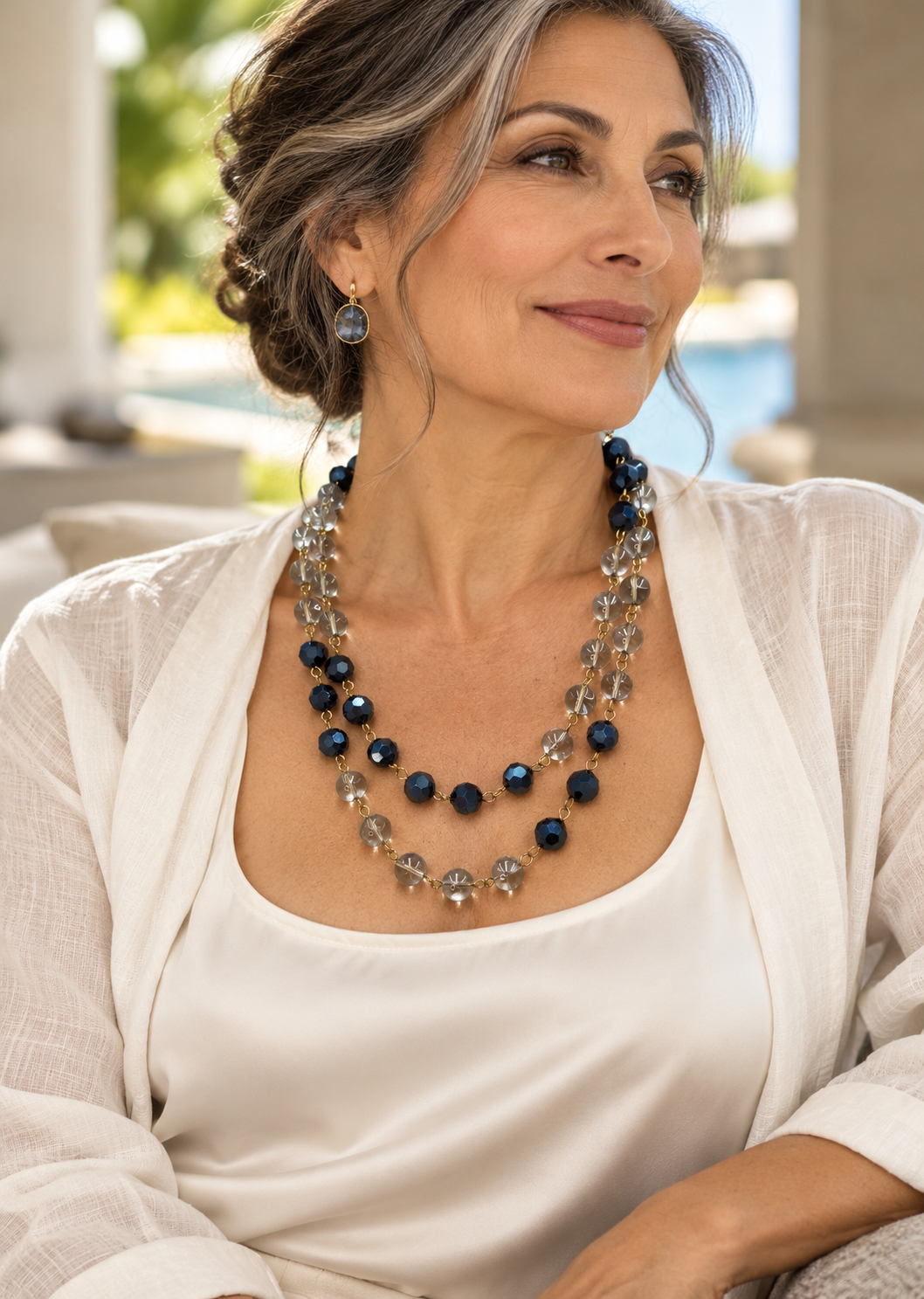
At 120cm, this necklace combines deep blue-black faceted glass beads with translucent smoky-grey glass, connected through individually hand-turned gold-tone brass links.
The contrast between the materials gives the piece its distinctive character.
The darker beads provide definition. The translucent beads introduce lightness and movement. The brass links create a subtle rhythm throughout the strand.
Worn long, the necklace forms a fluid vertical line.
Doubled, the same materials become two graduated layers, bringing the colours and textures closer together.
It can also be arranged more closely around the neckline, creating a different composition without introducing another piece of jewellery.
I find this particularly satisfying about designing long necklaces.
The woman wearing the piece can decide how she wishes to express it.
Beautiful to Wear. Simple to Live With.
One question I consider throughout the design process is whether a necklace will be easy to wear.
Beautiful jewellery should not require complicated arrangements or constant adjustment.
The 120cm length of After the Rain allows it to slip over the head without having to manage a small clasp.
It can be worn as a single strand or arranged into shorter layers according to the neckline, clothing and occasion.
The individually hand-linked construction allows the strand to move and fall naturally rather than behave as a rigid form.
These are quiet but important considerations.
Ease of wear is not separate from good design. It is part of it.
I want the experience of putting on a necklace to feel as considered as the experience of wearing it.
Jewellery for the Wardrobe She Already Owns
I also think about the relationship between a necklace and the clothes a woman already enjoys wearing.
A beautifully cut linen shirt. A simple navy dress. A tailored jacket. An understated evening outfit.
These pieces often need very little.
The right necklace can introduce colour, contrast and individuality without overwhelming the clothing or the woman wearing it.
The cool tones of After the Rain sit naturally against ivory, white, charcoal and navy. Its different arrangements allow the proportions to change with the neckline.
A long strand can bring definition to a simple outfit. Doubled layers create a more concentrated presence.
The intention is not to build an entirely new wardrobe around a necklace.
It is to create something distinctive that belongs within a wardrobe already shaped by personal taste.
Why I Choose to Hand-Link
Each necklace in the Glasshouse Collection is individually handcrafted in Brisbane, Queensland.
For After the Rain, I use gold-tone brass artistic wire, forming and turning the links that connect each bead.
Hand-linking is a deliberate choice.
It gives me the freedom to consider the arrangement as the necklace develops, refining the sequence, spacing and relationship between the materials.
It also creates the flexibility that allows longer strands to fall naturally and adapt to different arrangements.
The process requires patience and attention, but I value the freedom it provides.
A necklace is more than a collection of individual beads. Its rhythm, proportions and movement must work together.
Entirely Her Own
I design jewellery for women who have developed their own sense of style. Women who understand what they enjoy wearing, who recognise the appeal of beautiful materials, and who make choices without needing approval or reassurance.
A necklace may add definition to an outfit or introduce an unexpected combination of colour and texture.
But it does not need to transform the woman wearing it. She brings her own character, experience and individuality.
The jewellery becomes part of her expression.
That is the philosophy behind Glasshouse, and behind Collane con Passione.
Entirely her own.
Joanne
Designer, Collane con Passione
Handcrafted in Brisbane, Australia
Comments